

Student Project: Linear Axis
As part of their specialized project to earn their university-preparatory diploma, three students from BBS2 in Aurich worked on the “Linear Axis” project at the Emden/Leer University of Applied Sciences in the Mechatronics Laboratory. The goal was to maximize the travel speed of a linear axis consisting of a stepper motor, a coupling, a ball screw, and a linear rail with a carriage.
Structure
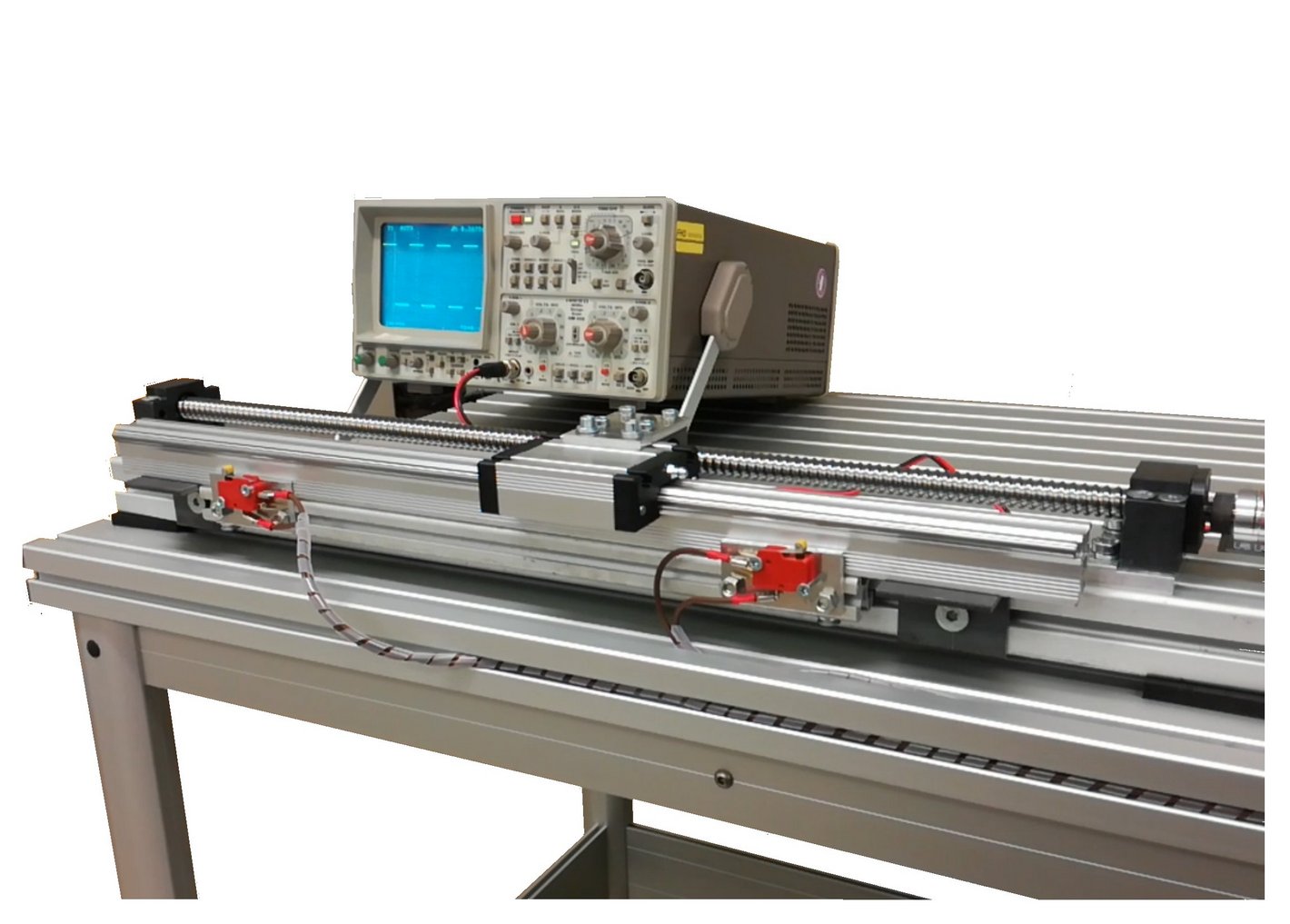
The project participants were given instructions on how to set up the experimental setup. The most important part of the project assignment was to connect a PC with an Arduino development environment to a stepper motor via an Arduino and a stepper motor driver.
The project assignment included familiarizing themselves with and developing a technical understanding of the components of the experimental setup, as well as learning how to program the Arduino development board.

Clock signal

The Arduino is responsible for generating a clock signal that can be used to drive the stepper motor driver. The Arduino generates the clock signal by continuously turning a digital output on and off. The duration of the HIGH and LOW states is controlled by delay times in the microsecond range within the program.
Stepper Motor Driver

The stepper motor driver is responsible for converting the clock signal at the "Pulse" input into the current drive pattern for the stepper motor’s coils. Each pulse at the "Pulse" input causes the motor to take a step of 1.8° (200 steps for a full rotation).
In addition, the driver offers the option to switch from full-step to microstep mode. In this case, the stepper motor requires, for example, 800 pulses for one full revolution. This allows for smoother and quieter motor operation, but at the same time results in a slight loss of torque.
Video 2 - The motor moves along an acceleration ramp
At the start, the motor is driven at the maximum speed achievable from a standstill. The clock frequency used to control the stepper motor driver is then gradually increased. The clock frequency can continue to be increased until the step motor’s decreasing torque curve no longer allows for further increases at higher speeds.
Search