

Exhibits
Gleitlagerkoffer Igus


On display is a collection of igus plain bearings. With plain bearings, the material determines their properties.
The templates below can be used to find the right material for the right application. By placing the templates over the plain bearings, you can see which bearings can be used under which conditions.
In this example, the template for dirt-resistant bearings was used. If a bearing needs to withstand multiple demanding conditions, the templates can also be stacked on top of one another. The charts also make it easy to see that there is no such thing as a perfect material or a perfect plain bearing that is suitable for all applications under all conditions.
This page provides an overview of the bearings on display in Laboratory T52 at the University of Applied Sciences Emden/Leer. It begins with a general overview of what bearings are, how they work, and the different types of bearings.
This is followed by a closer look at the exhibits in the glass display case, along with background information.
The bearing demonstrator on display on the table is also explained.
SKF Bearing Case

On display is a case containing several bearings manufactured by SKF. The bearings can be removed individually, and some can also be disassembled. A cross-section of each bearing is printed on the back of the respective bearing.
Larger models of the self-aligning roller bearings and the cylindrical roller bearings are on display, allowing visitors to better see their internal structure.
Self-aligning roller bearings
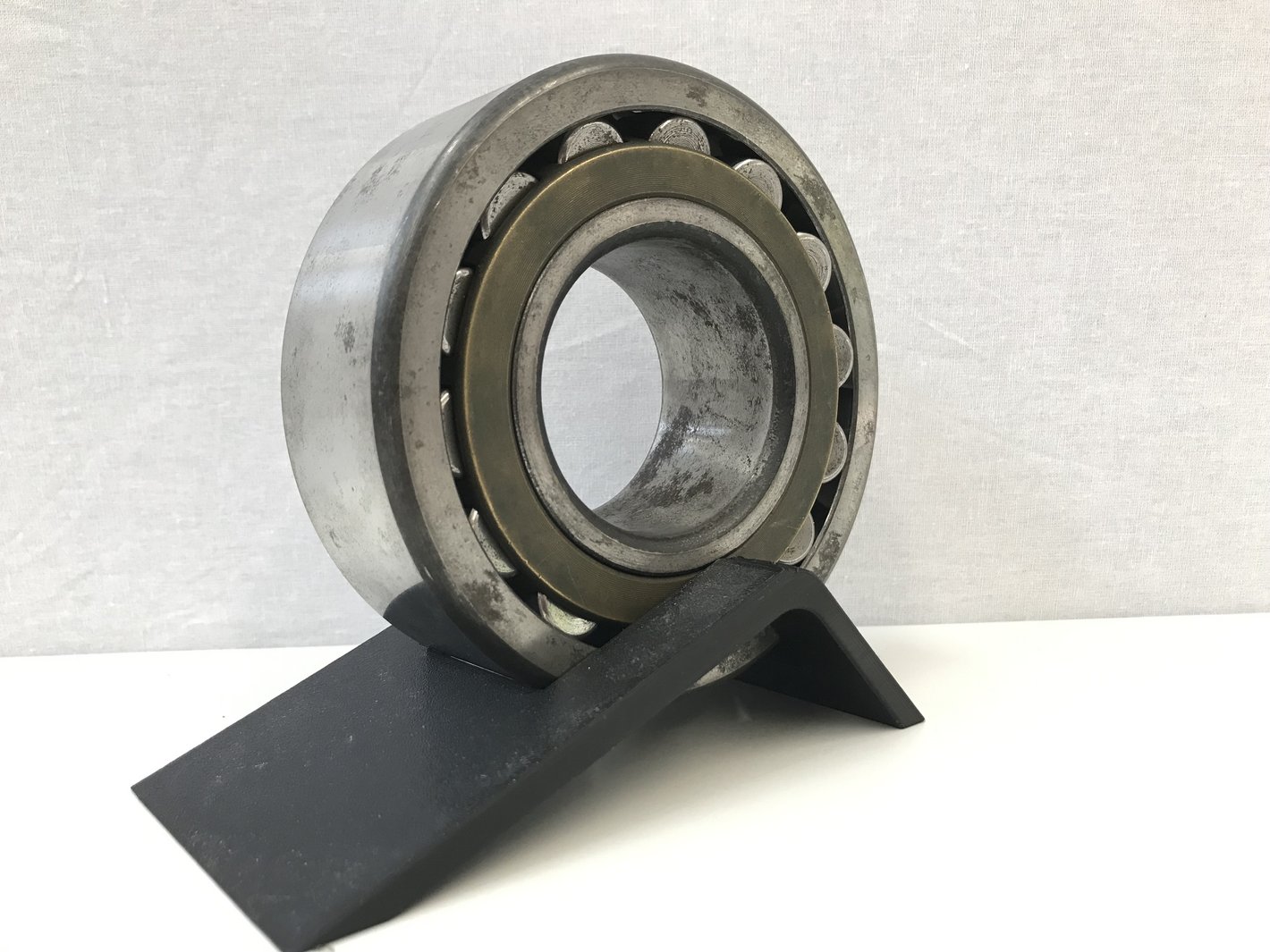
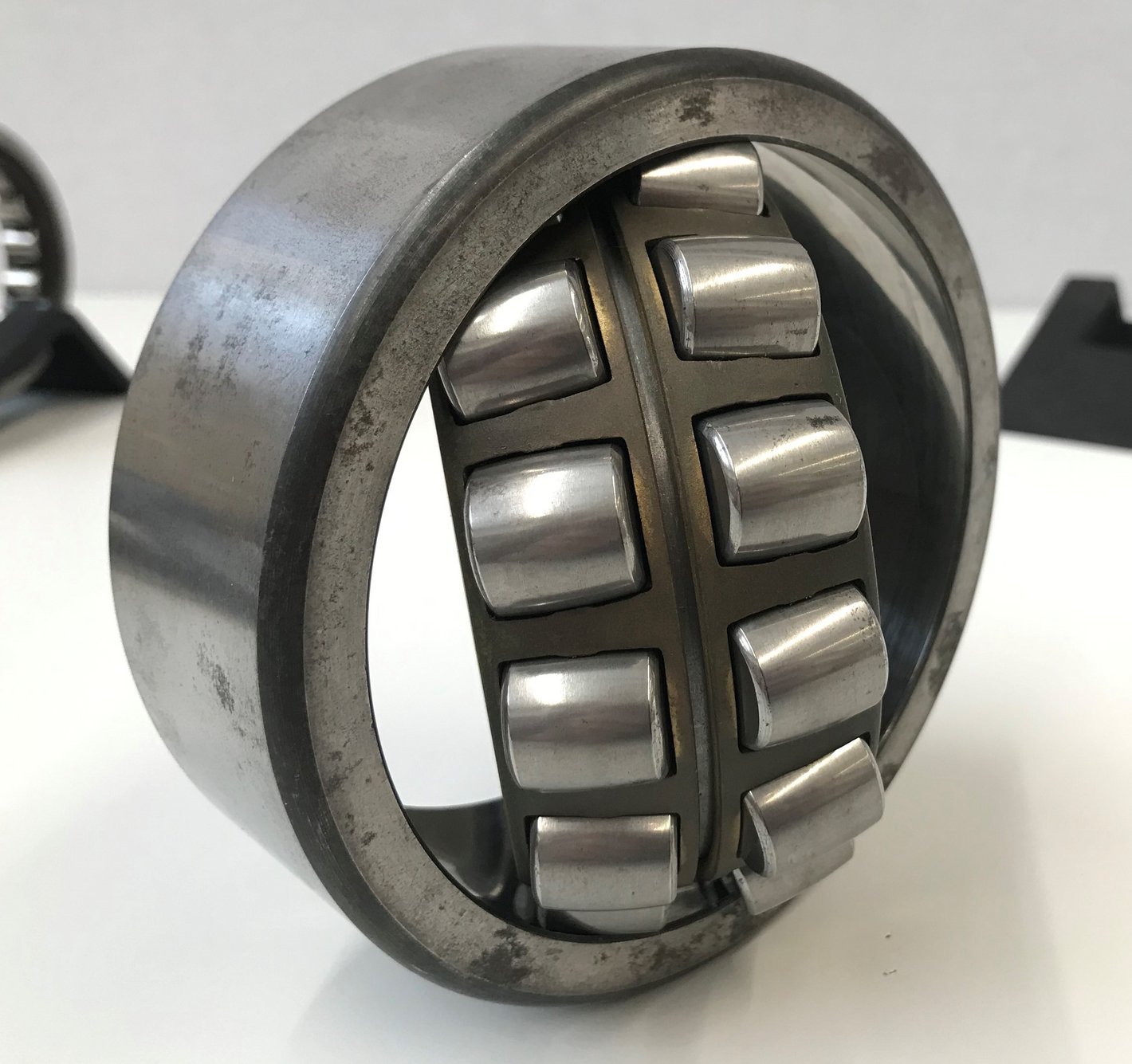
The spherical roller bearing displayed in the SKF case at the top right is designated 21305 CC. Since this bearing was manufactured by SKF, its characteristics can be determined using SKF’s designation system . In this case, the five-digit number represents the bearing series, the dimensional series, and the size of the bearing—that is, the inner diameter. The designation CC stands for two sheet-steel window cages, a flangeless inner ring, and a guide ring centered on it. The manufacturing process for this type of bearing is explained in this video.
In contrast, the self-aligning roller bearing shown here is considerably larger. Self-aligning roller bearings are suitable for use with high, shock-like radial forces and, depending on their design, also for axial forces. The difference between a self-aligning roller bearing and a barrel bearing lies in their design. A self-aligning roller bearing has two rows of symmetrical barrel rollers, as can be seen in the image below. The bearings are also angularly adjustable because they have a hollow-spherical raceway on the outer ring, allowing them to compensate for angular shaft misalignment and misalignment of the bearing seats. [1]
Cylindrical roller bearings

Cylindrical roller bearings have a high radial load capacity and high rigidity. They cannot withstand axial loads, or can only withstand very small ones. The exhibit shown here is missing its inner ring, so the cylindrical rollers are clearly visible.
This design without an inner ring is used to save space. To install such a bearing, the surface of the shaft (like the raceway of a rolling bearing) must be hardened and ground.
Examples of applications: gearboxes, electric motors, axle bearings in rail vehicles. [9]
Bearing Selection

Three different bearings are installed in the bearing holder shown:
- Bearing A: Needle roller bearing without inner ring (Model: IKO TAF 253316)
- Bearing B: Needle roller bearing cage
- Bearing C: Double-row angular contact ball bearing (Model: SKF 3200 ATN9)
A major advantage of (cage-guided) needle roller bearings is their very low overall height combined with high load-carrying capacity. For this reason, they are often used in small automotive transmissions (e-axle transmissions). [10]
Bearing Seals


There are various types of seals used in bearings. The SKF bearings on display feature three different seal types: without seals, with cover plates on both sides, and with sealing washers on both sides.
Bearings without seals are used for particularly smooth operation. They offer no protection against contaminants of any kind, but the absence of a seal makes relubrication easier. Cover plates on both sides protect the bearings from coarse contaminants. Fine dust particles can still enter the bearing, however. The maximum speed is not limited in this design. Sealing washers on both sides are usually made of a rubber-like material that seals the bearing, sometimes reinforced with sheet steel on the inside. Since the bearing is thus sealed by contact and additional friction arises at the sealing contact, the maximum rotational speed is reduced by about 40 percent. [4][6]
The extent to which rotational resistance increases in a sealed deep-groove ball bearing can be tested, for example, using the bearing demonstrator on display on the table.
The Life Cycle of a Deep Groove Ball Bearing

The demonstrator illustrates the individual processes involved in manufacturing the components of a deep-groove ball bearing. To supplement the description of the manufacturing of the rolling elements and the cage shown there, the following section explains the production of the inner and outer rings in greater detail:
The manufacturing of the inner and outer rings follows a similar process. First, the inner bore is machined into a steel bar and the outer diameter is turned accordingly, after which the required inner and outer shapes are machined. This component is cut off from the steel bar and hardened. Next, the sides and outer diameters of both the inner and outer rings are ground. For the outer ring, the inner raceway is then ground, and for the inner ring, the outer raceway of the roller bearings is ground. Finally, the bore of the inner ring is also ground.
An additional step after complete assembly, depending on the model, is the application of grease and the installation of a seal. [8]
Disc Springs
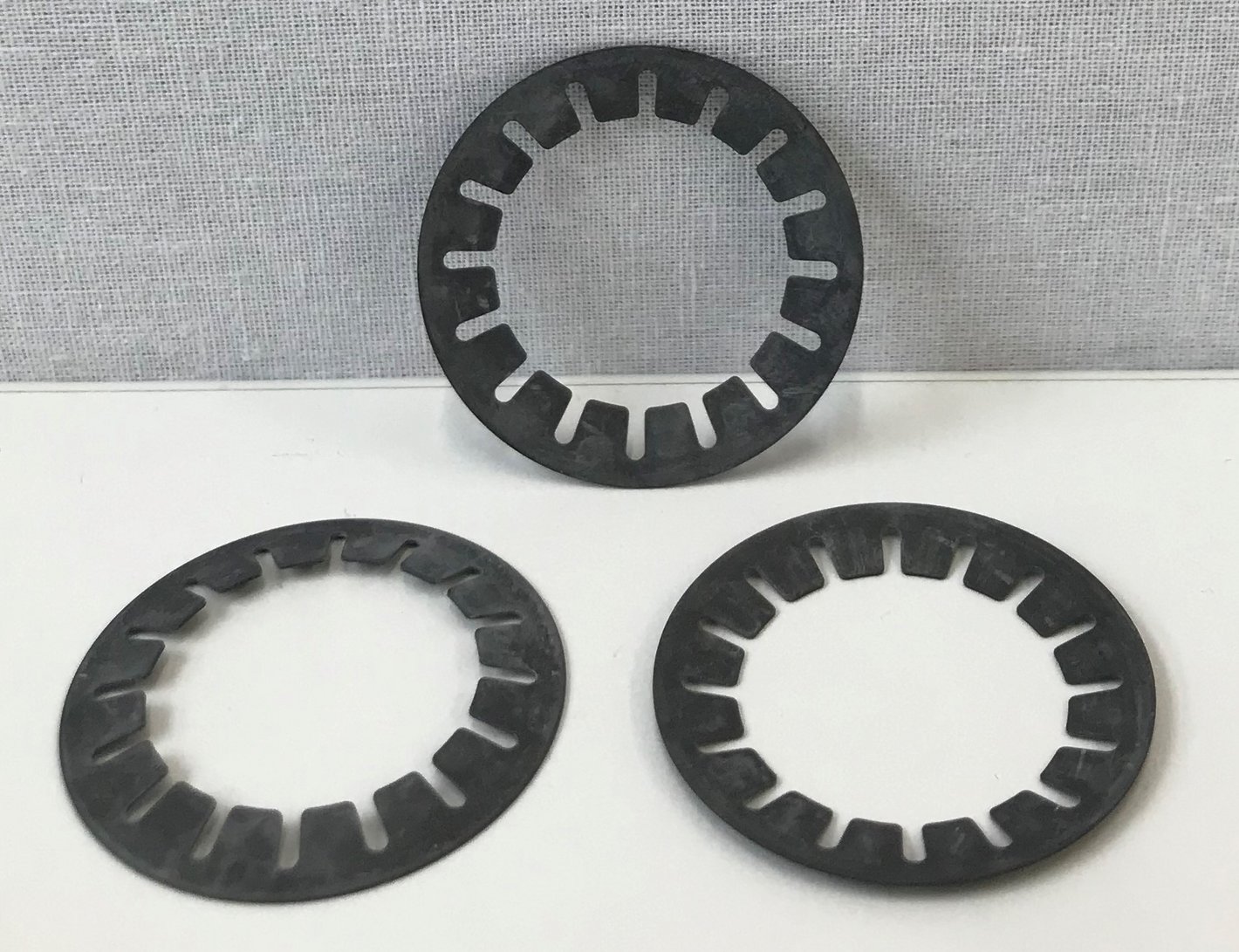
Disc springs can be loaded in the axial direction, either statically or dynamically. Depending on the application, disc springs can be used individually or in stacks.
Slotted disc springs, as shown in the figure, are used with ball bearings for axial preload. This allows for compensating for potential dimensional deviations or applying minimum loads. [7]
Bearing Mounting with Bearing Sockets


These two exhibits are intended to represent a shaft mounted with two deep-groove ball bearings. The demonstrator with the spur gear shows a bearing arrangement with bearing housings, while the demonstrator without the spur gear shows a bearing arrangement without bearing housings. Both demonstrators feature a split in the shaft plane. The advantage of bearing shells lies in the reduction of manufacturing effort for the surrounding component when the shaft is split in the plane: This means that only one part (the bearing housing) needs to be manufactured to tight tolerances, while the other parts (housing halves) can be manufactured to looser tolerances.
General Information About Bearings
What is a bearing?
"Bearings are designed to support and guide parts in machines and devices that move relative to one another—particularly those that rotate—and to absorb the external forces acting on them (transverse, longitudinal, and/or oblique to the axis of motion) and transfer them to foundations, housings, or similar components (function). The resulting assembly is referred to as a bearing arrangement .” — Roloff/Matek Machine Elements [1]
A bearing must fulfill two essential functions:
- Transmit motion
- Transmit forces [2]
How is a bearing constructed?
The design of a plain bearing depends on the forces it must accommodate, but it is kept simple. If only radial forces are involved, cylindrical bushings are sufficient. If, however, axial forces are also present, flanged bushings are used, in which the cylindrical shape is extended on one side to form a circumferential flange. Thanks to their compact and less complex design, plain bearings require less space and are easier to install. [3]
A rolling bearing, on the other hand, consists of the following components:
- Two rings or discs with raceways
- Rolling elements
- A cage
Theinner and outer rings are usually made of high-purity, chromium-alloyed special steel, which possesses the required hardness and purity. These properties are essential for high load-carrying capacity and a long service life. However, special materials such as ceramics or plastics are also used. Compared to steel, plastics are very lightweight but cannot withstand extremely high temperatures. They are used, among other places, in the automotive industry, where every gram of weight counts. The raceways are hardened, ground, and honed. [2]
Rolling elements can be balls, rollers, cones, barrels, or needles. These are also usually made of high-purity chromium-alloyedspecial steel. In addition, special materials such as ceramics or plastics are also used. The rolling elements roll on the rings or discs. [2]
The cage serves to keep therolling elements spaced apart and to guide them. Steel, brass, and plastic, for example, are used for this purpose. The manufacturing process varies depending on the material, as metal cages can be produced as solid parts—for example, through machining—or from sheet metal. Plastic cages can also be manufactured as solid parts through machining or by injection molding. [2]
What types of bearings are there?
Bearings can be classified according to five key criteria: [1]
- Operating principle ( sliding bearings, rolling bearings, magnetic bearings)
- Direction of the bearing force F ( radial bearings, axial bearings)
- Function ( fixed bearing, support bearing, idler bearing)
- Design ( shaft bearings, eye bearings, flange bearings, spherical and self-aligning bearings, built-in bearings)
- Installation options ( split bearings, solid bearings, dismountable bearings)
The most common bearing designations (rolling bearings, plain bearings, radial bearings, and axial bearings) are explained below.
Rolling-element bearings and plain bearings
In plain bearings, the shaft and bearing move against each other on a sliding surface. In contrast, in rolling bearings, the two components that move relative to each other (inner and outer rings) are separated by rolling elements. The friction involved is lower than that of a plain bearing. [2]
Radial Bearings and Thrust Bearings
Rolling bearings can transmit forces in the radial (perpendicular to the shaft axis) and/or axial (along the shaft axis) directions. A combination of these loads is common in many applications, and both radial and axial bearings can be designed as ball bearings or roller bearings. [2]
Types of Rolling Bearings
The most common types of rolling bearings are briefly explained below. These can also be found in the SKF bearing case on display.
- Deep-groove ball bearings: Designed to withstand primarily radial forces, but also axial forces; single-row, straight arrangement of rolling elements
- Double-row deep-groove ball bearings: designed to withstand radial and axial forces; double-row, straight arrangement of rolling elements
- Self-aligning ball bearings: Absorb radial and axial forces; double-row, straight arrangement of rolling elements
- Angular contact ball bearings: designed to withstand radial and axial forces; single-row, angular arrangement of rolling elements
- Axial deep groove ball bearings: designed to support exclusively axial forces; single-row, vertical arrangement of rolling elements
- Cylindrical roller bearings: Absorb high radial as well as axial forces; single-row, straight arrangement of rolling elements
- Tapered roller bearings: designed to withstand high radial and axial forces; single-row, angled arrangement of rolling elements
- Axial cylindrical roller bearings: designed to withstand exclusively axial forces; single-row, vertical arrangement of rolling elements
In general, roller bearings are used as an alternative to ball bearings when higher forces need to be transmitted. This is made possible by the larger contact area compared to ball bearings. [5]
Bearing Demonstrator
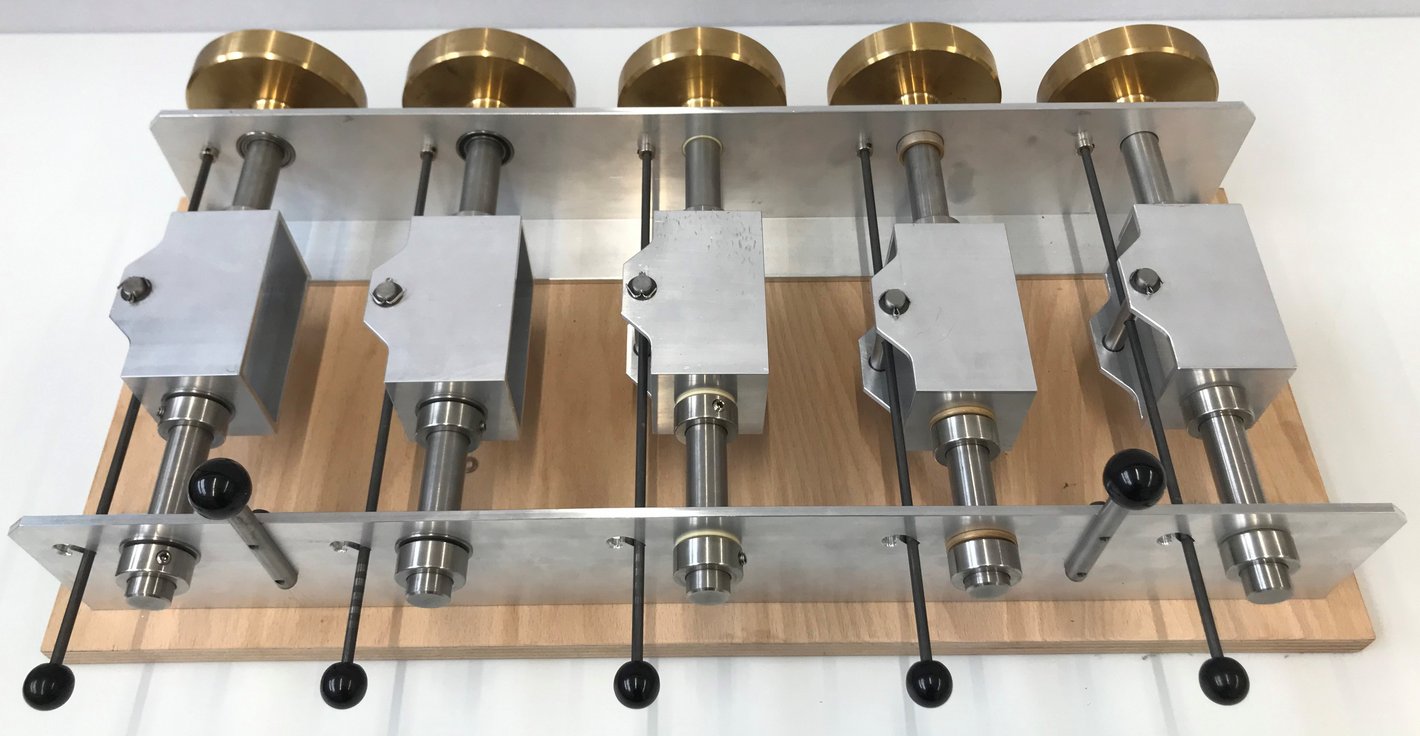
On the table next to the glass display case is a bearing demonstrator. This is used to illustrate how and whether bearings can be used when subjected to external forces.
Five types of bearing arrangements, each with four bearing points, were installed:
- Unsupported
- Copper bushing
- Plain bearing bushing
- Sealed deep-groove ball bearing
- Open deep-groove ball bearing
In the initial position, no external forces act on the bearings.
Instructions:
- Rotate the brass disc—bearing behavior without external force
- Secure the lever with the black knob to demonstrate the application of a force
- Rotate the brass disc—observe the bearing’s behavior under load
Bibliography
[1] Wittel, H., Muhs, D., Jannasch, D., Voßiek, J. (2013). Roloff/Matek Machine Elements. Wiesbaden: Springer Fachmedien, 2013.
[2] NSK-Europe. What Is a Rolling Element Bearing?, available at: https://www.nskeurope.de/de/bearings/products/what-s-a-bearing.html (accessed on October 20, 2022).
[3] konstruktions praxis. Plain Bearings—Basics, Properties, and Applications, available at: https://www.konstruktionspraxis.vogel.de/gleitlager-grundlagen-eigenschaften-und-anwendungen-a-764887/ (accessed October 20, 2022).
[4] GAP Kugellager OHG. Technical Information on Rolling Bearings, available at: https://www.gap-kugellager.de/info/technische-informationen.html?language=de (accessed October 24, 2022).
[5] Upffront GmbH. The Difference Between Plain, Ball, and Roller Bearings, available at: https://info.upffront.com/de/blog/der-unterschied-zwischen-gleit-kugel-und-rollenlagern (accessed October 26, 2022).
[6] Kugellager-Express GmbH. Find the Right Seal Here, available at: https://www.kugellager-express.de/Infos-Kugellager-Dichtungen (accessed November 1, 2022).
[7] Alcomex Federn GmbH. Disc Spring Applications, at: https://www.alcomex.de/tellerfedern-anwendung/ (accessed on November 1, 2022).
[8] JESA SA. Flowchart of Ball Bearing Production, available at: https://www.jesa.com/de/dokumentation/technische-dokumentation/ablaufplan-der-kugellagerfertigung/ (accessed November 8, 2022).
[9] Wittel, H., Spura, C., Jannasch, D. (2021). Roloff/Matek Machine Elements. Wiesbaden: Springer Vieweg, 2021
[10] Schaeffler AG. A Revolution in Bearing Technology—The Caged Needle Roller Bearing, available at: https://www.schaeffler.com/de/medien/storys/storys-produkte/70-jahre-kaefiggefuehrtes-nadellager/(accessed November 11, 2022).
Search